Marketing has changed dramatically over the last decade. Businesses that once relied on newspapers, television, radio, and billboards are now embracing artificial intelligence (AI) to automate campaigns, analyze customer behavior, and improve marketing performance. As technology continues to evolve, many businesses are asking an important question: AI vs Traditional Marketing—which one is better?
Both approaches have their strengths and weaknesses. Traditional marketing focuses on human creativity and offline communication, while AI-driven marketing uses data, automation, and machine learning to reach the right audience at the right time.
In this blog, we’ll compare AI vs Traditional Marketing, explore their advantages, differences, challenges, and help you decide which strategy is best for your business in 2026.
Understanding AI-Powered Marketing
Artificial Intelligence (AI) marketing uses advanced technologies such as machine learning, predictive analytics, natural language processing, and automation to improve marketing campaigns.
AI helps businesses:
- Analyze customer behavior
- Personalize marketing messages
- Automate repetitive tasks
- Predict future buying trends
- Improve advertising performance
- Increase conversion rates
Popular AI marketing tools include ChatGPT, Google Gemini, HubSpot AI, Jasper AI, and Microsoft Copilot.
What Is Traditional Marketing?
Traditional marketing refers to promotional methods that existed before digital technology became mainstream. These methods are designed to reach audiences through offline channels.
Common examples include:
- Television advertisements
- Newspaper advertisements
- Radio commercials
- Billboards
- Flyers and brochures
- Direct mail
- Magazine advertising
Traditional marketing is still effective for building local brand awareness and reaching audiences who may not spend much time online.
Key Differences Between AI and Conventional Marketing
Understanding the major differences between AI vs Traditional Marketing helps businesses choose the right strategy.
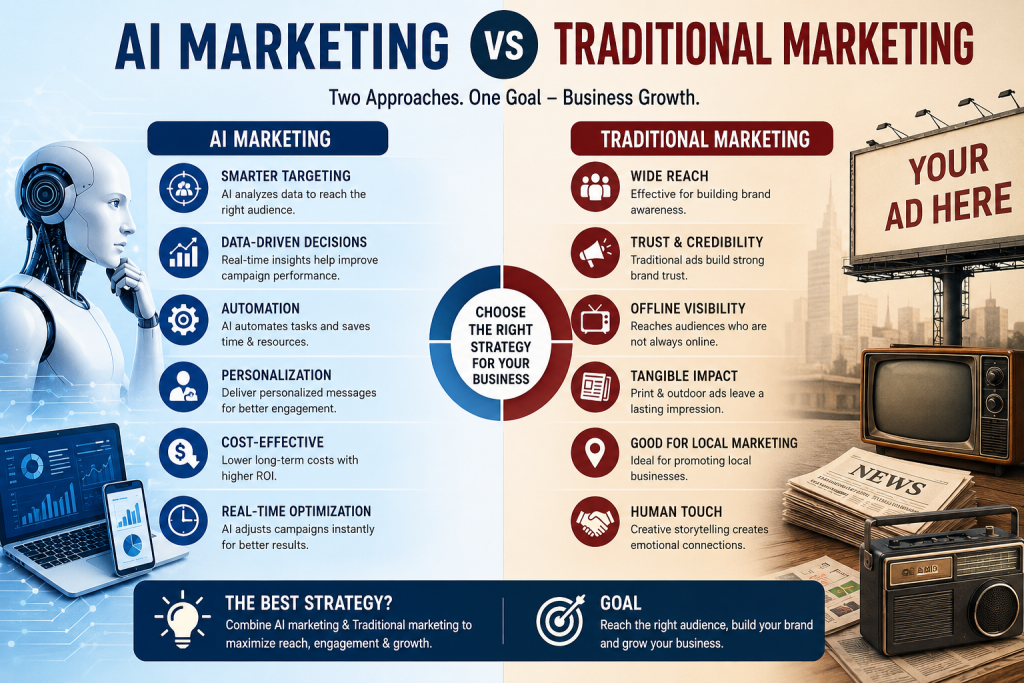
| AI Marketing | Traditional Marketing |
| Uses automation | Mostly manual |
| Data-driven decisions | Experience-based decisions |
| Personalized campaigns | General audience messaging |
| Real-time analytics | Limited performance tracking |
| Lower long-term costs | Higher advertising costs |
| Fast campaign optimization | Slow optimization process |
The biggest advantage of AI is its ability to process large amounts of data quickly and improve marketing performance automatically.
Benefits of AI vs Traditional Marketing for Businesses
Businesses are increasingly adopting AI because it improves efficiency and delivers measurable results.
Major benefits include:
- Personalized customer experiences
- Better audience targeting
- Faster campaign optimization
- Reduced marketing costs
- Improved customer support through chatbots
- Predictive analytics
- Higher return on investment (ROI)
- Automated email marketing
- Smarter content recommendations
- AI vs Traditional Marketing
AI enables marketers to focus more on strategy while repetitive tasks are handled automatically.
Advantages of Traditional Marketing Methods
Although AI is becoming more popular, traditional marketing still offers several important advantages.
Some benefits include:
- Builds trust through physical advertising
- Effective for local businesses
- Strong brand recognition
- Reaches audiences without internet access
- Memorable print and outdoor advertisements
- Works well for community-based promotions
Many successful companies continue to combine traditional advertising with digital strategies.
Cost Comparison: AI vs Traditional Marketing
Cost is one of the biggest factors businesses consider before choosing a marketing strategy.
AI marketing generally requires an initial investment in software and tools but reduces long-term operating costs through automation.
Traditional marketing often involves recurring expenses such as:
- Newspaper space
- Television airtime
- Radio advertising
- Printing brochures
- Billboard rentals
For small businesses with limited budgets, AI-powered marketing usually provides better cost efficiency and measurable returns.
AI vs Traditional Marketing: Customer Engagement Comparison
Customer engagement has become one of the most important marketing goals.
AI improves engagement by delivering:
- Personalized emails
- Product recommendations
- Chatbot support
- Customized advertisements
- Automated follow-ups
Traditional marketing mainly communicates through one-way channels such as television, newspapers, or outdoor advertising, making interaction more limited.
Businesses looking for continuous customer engagement often benefit from AI-powered solutions.
Challenges of Artificial Intelligence in Marketing
Despite its advantages, AI also has limitations.
Some common challenges include:
- Initial learning curve
- Dependence on quality data
- Privacy concerns
- Higher setup costs
- Need for skilled professionals
- Risk of over-automation
AI works best when combined with human creativity rather than replacing it completely.
AI vs Traditional Marketing: Limitations of Traditional Marketing
Traditional marketing also faces several challenges in today’s competitive environment….AI vs Traditional Marketing
Some limitations include:
- Difficult to measure campaign success
- Higher advertising costs
- Limited audience targeting
- Less flexibility
- Slower campaign updates
- Lower personalization
These limitations have encouraged many businesses to shift toward AI-assisted marketing solutions.
Which Marketing Approach Delivers Better Results?
The answer depends on your business goals.
Choose AI marketing if you want:
- Better targeting
- Real-time analytics
- Marketing automation
- Personalized campaigns
- Higher ROI
- Faster optimization
Choose traditional marketing if you want:
- Strong local visibility
- Offline audience reach
- Community promotions
- Print branding
- Television or radio advertising
For most businesses in 2026, combining both approaches creates the strongest marketing strategy.
Future of AI vs Traditional Marketing in 2026
Marketing continues to evolve rapidly.
Future trends include:
- AI-generated content
- Voice search optimization
- Hyper-personalized advertising
- Predictive customer analytics
- AI chatbots
- Marketing automation
- Augmented Reality (AR)
- Virtual Reality (VR)
- Omnichannel marketing
- Privacy-focused advertising
Traditional marketing is unlikely to disappear completely, but AI will continue to play a larger role in improving efficiency and customer experience.
AI vs Traditional Marketing: Which Strategy Should You Choose?
Instead of choosing one method over the other, businesses should integrate both AI and traditional marketing.
For example:
- Use billboards for local awareness.
- Run AI-powered Google Ads for online leads.
- Print brochures for exhibitions.
- Use AI email automation to nurture customers.
- Promote events through newspapers and social media simultaneously.
A balanced strategy helps businesses maximize reach while maintaining strong customer relationships.
Conclusion
The debate around AI vs Traditional Marketing is not about replacing one with the other. Instead, it is about understanding how each approach contributes to business growth. AI offers speed, automation, personalization, and data-driven decision-making, while traditional marketing provides credibility, offline visibility, and stronger local connections.
Businesses that successfully combine AI technology with traditional marketing techniques are more likely to achieve sustainable growth in 2026 and beyond. As customer expectations continue to evolve, marketers who embrace innovation while preserving human creativity will have the greatest competitive advantage. Learn more about AI marketing
Frequently Asked Questions (FAQs)
1. What is the main difference between AI vs Traditional Marketing?
AI marketing relies on automation, data analysis, and personalization, while traditional marketing focuses on offline channels such as TV, newspapers, radio, and print advertising.
2. Is AI marketing replacing traditional marketing?
No. AI is enhancing marketing strategies, but traditional marketing still plays an important role, especially for local branding and offline audiences.
3. Which is more cost-effective: AI or Traditional Marketing?
AI marketing is generally more cost-effective in the long run because it automates tasks, improves targeting, and provides measurable campaign performance.
4. Can businesses use both AI and traditional marketing together?
Yes. Combining AI-powered digital campaigns with traditional advertising often delivers the best results by reaching both online and offline audiences.
5. Is AI marketing suitable for small businesses?
Yes. Many affordable AI tools help small businesses automate marketing, improve customer engagement, and compete more effectively with larger brands. Read our complete marketing guide