
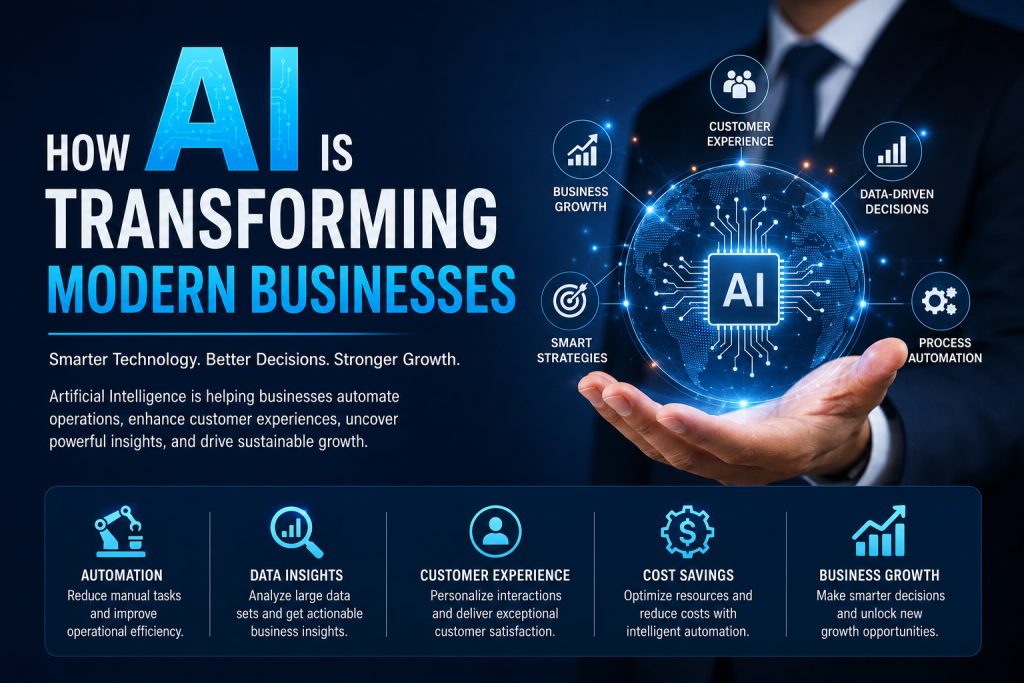
How AI is Transforming Modern Businesses
Artificial intelligence is no longer a futuristic concept—it has become an essential part of modern business operations. From startups to multinational corporations, organizations are embracing AI to improve productivity, automate repetitive tasks, and make smarter business decisions. As technology continues to evolve, AI in business transformation is enabling companies to deliver better customer experiences, optimize workflows, and gain a competitive advantage.
Whether it’s customer support, marketing, finance, healthcare, or manufacturing, businesses are investing heavily in AI-powered solutions. Understanding how AI in business transformation works can help companies prepare for the future and stay ahead in an increasingly competitive market.
Understanding AI in Business Transformation
AI in business transformation refers to the use of artificial intelligence technologies to improve business processes, automate operations, analyze large amounts of data, and support better decision-making.
Instead of relying only on manual work, businesses now use AI-powered software to handle repetitive tasks, identify patterns, predict customer behavior, and improve efficiency. This allows employees to focus on more strategic and creative responsibilities while AI manages routine operations.
Benefits of Artificial Intelligence for Business Growth
One of the biggest reasons companies invest in AI in business transformation is the wide range of business benefits it offers.
Some major advantages include:
- Increased productivity
- Faster decision-making
- Reduced operational costs
- Better customer satisfaction
- Improved data analysis
- Enhanced cybersecurity
- Personalized customer experiences
- Higher profitability
These benefits help businesses grow faster while maintaining operational efficiency.
AI-Powered Automation in Modern Organizations
Automation is one of the strongest pillars of AI in business transformation. Businesses use AI to automate repetitive and time-consuming tasks such as invoice processing, customer support, appointment scheduling, report generation, and inventory management.
AI-powered automation not only saves time but also reduces human error. Employees can focus on innovation and problem-solving instead of spending hours on repetitive administrative work.
Business Intelligence Through Artificial Intelligence
Data has become one of the most valuable assets for organizations. AI in business transformation enables companies to analyze massive datasets within seconds and generate meaningful insights.
AI helps businesses:
- Predict customer demand
- Identify buying patterns
- Detect fraud
- Forecast sales
- Improve inventory planning
- Support strategic decisions
These insights allow organizations to make informed business decisions based on real-time data instead of assumptions.
Customer Experience with AI-Driven Business Solutions
Customer expectations continue to rise, making personalized experiences more important than ever. AI in business transformation helps businesses understand customer preferences and deliver customized recommendations.
Examples include:
- AI chatbots
- Personalized product suggestions
- Smart email campaigns
- Voice assistants
- Recommendation engines
- Automated customer support
These technologies improve customer satisfaction while reducing response times.
AI-Based Marketing and Sales Optimization
Marketing has changed significantly because of AI in business transformation. Businesses can now analyze customer behavior, optimize advertising campaigns, and create personalized marketing messages.
AI helps marketers:
- Identify target audiences
- Improve ad performance
- Optimize email campaigns
- Generate content ideas
- Predict customer purchases
- Increase conversion rates
Sales teams also benefit by identifying qualified leads and improving customer engagement.
AI in Finance, HR, and Business Operations
The impact of AI in business transformation extends beyond marketing.
In finance, AI helps with:
- Fraud detection
- Risk analysis
- Expense management
- Financial forecasting
In Human Resources, AI supports:
- Resume screening
- Employee onboarding
- Performance analysis
- Workforce planning
Across business operations, AI improves efficiency by automating workflows and reducing manual processes.
Challenges of AI in Digital Business Transformation
Although AI in business transformation offers significant advantages, businesses must also address several challenges.
Common challenges include:
- High implementation costs
- Employee training
- Data privacy concerns
- Cybersecurity risks
- Integration with existing systems
- Dependence on quality data
Organizations that plan carefully and invest in employee training can overcome these challenges successfully.
Future of AI-Driven Enterprise Transformation
The future of AI in business transformation looks incredibly promising. Businesses are expected to adopt more advanced AI technologies over the coming years.
Emerging trends include:
- Generative AI
- Predictive analytics
- Autonomous business operations
- AI-powered cybersecurity
- Voice commerce
- Hyper-personalization
- Intelligent automation
- Digital twins
Companies that embrace innovation early will be better positioned for long-term success.
Why Every Business Should Invest in AI Innovation
Regardless of company size, provides opportunities to improve efficiency, reduce costs, and deliver better customer experiences.
Small businesses can automate repetitive tasks, while large enterprises can optimize complex operations across multiple departments. As AI technology becomes more affordable and accessible, businesses of all sizes can benefit from digital transformation initiatives.
Investing in AI today prepares organizations for tomorrow’s competitive marketplace.
Conclusion
AI in business transformation is reshaping the way companies operate, compete, and serve customers. From automation and predictive analytics to personalized marketing and intelligent decision-making, AI has become an essential tool for sustainable business growth.
Organizations that successfully implement gain higher efficiency, improved customer satisfaction, and stronger competitive advantages. While challenges such as implementation costs and data security remain, the long-term benefits far outweigh the risks. As artificial intelligence continues to evolve, businesses that adopt AI strategically will be better equipped to thrive in the digital economy. Business intelligence with AI
Frequently Asked Questions (FAQs)
1. What is AI in business transformation?
Is the use of artificial intelligence to automate business processes, improve decision-making, enhance customer experiences, and increase operational efficiency.
2. How does AI help businesses grow?
AI helps businesses reduce costs, automate repetitive tasks, improve marketing performance, analyze customer behavior, and make data-driven decisions.
3. Which industries benefit most from AI in business transformation?
Healthcare, finance, retail, manufacturing, education, logistics, e-commerce, and customer service are among the industries benefiting the most from AI adoption.
4. Is AI suitable for small businesses?
Yes. Many affordable AI tools allow small businesses to automate operations, improve customer support, and compete more effectively.
5. What is the future of AI in business transformation?
The future includes smarter automation, predictive analytics, AI-powered decision-making, personalized customer experiences, and increased business efficiency across industries.